
So the entire AI market is up in arms and freaked out about DeepSeek. Stocks are plummeting and VCs are questioning their investments. How could a small team, with an extremely limited budget, make something comparable to the AI products of major American corporations that spent hundreds of millions, if not billions on development, data centers, and custom AI chips? Simple, US companies became complacent.
Success breeds complacency
Complacency breeds failure.
Only the paranoid survive.
Andy Grove (Former CEO of Intel)
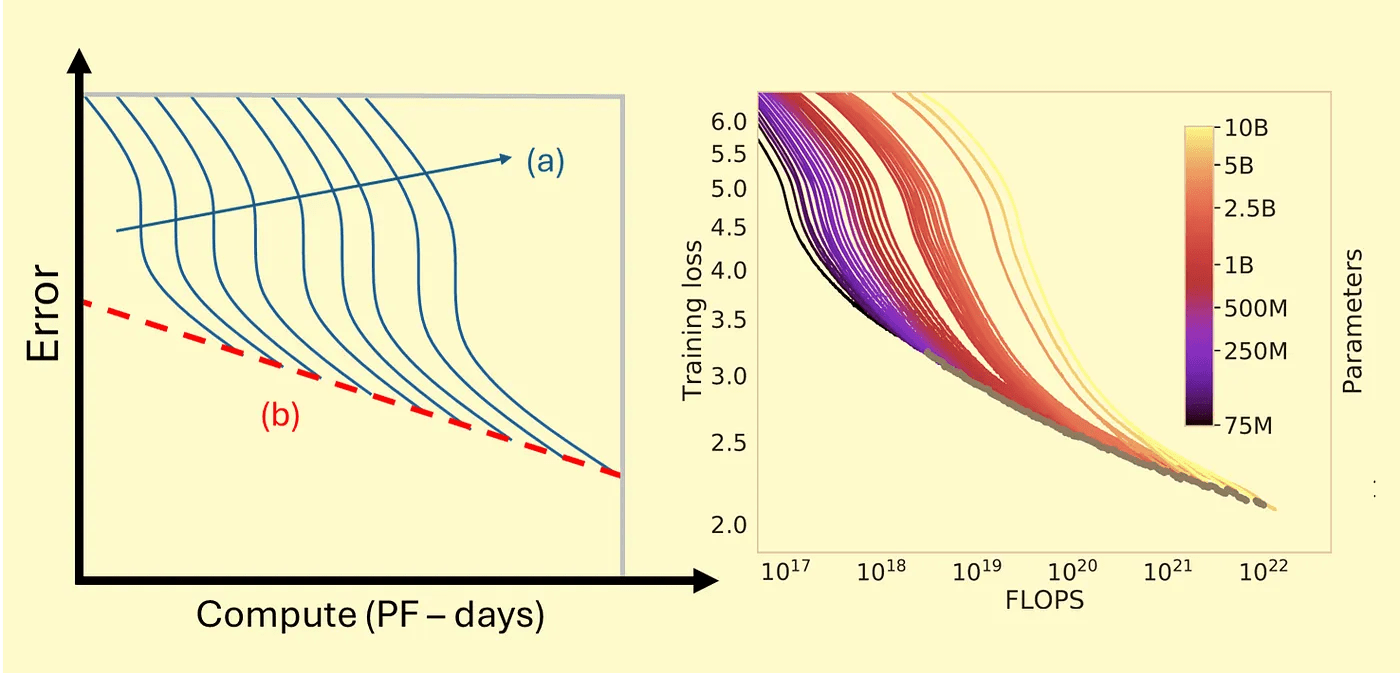
Sure it’s another quote, but what the hell. For the past couple of years, there have been tons of articles regarding the performance of AI models entering a potential phase of diminishing returns for the investment in equipment or training data set. Increase the training data set exponentially, it doesn’t produce an exponential improvement in accuracy. Add more processing capacity, and it only increases the speed models are trained, which allows for larger training sets. This is a textbook example of the law of diminishing returns. You need to spend exponentially more money for marginal increases in accuracy or performance.
And it’s not like American firms haven’t faced similar situations before. Intel (given the quote) is probably one of the best examples of this. They threw in with Itanium for 64bit microprocessor architecture, while AMD just expanded the existing x86 architecture with 64bit registers and instructions (a bit of a simplification of this, but it holds). AMD made a better product and Intel had to add in the x86-64 instruction set in it’s Pentium IV chips. Speaking of which, the Pentium IV microarchitecture was a MESS. While they were powerful, they had huge power requirements for the time, and generated tons of heat. It got to the point that Intel had to revert to the Pentium III Tualatin microarchitecture as the basis for the Core series of CPUs. Another good example is IBM with the PowerPC 970 series of CPUs (the infamous PowerPC G5 processor used in Macs). The CPU was very powerful, but they also had problems producing a low powered version that could be used in laptops. This heat and power issue were literally the reason why Apple moved to Intel CPUs.
So the panic over American companies being bested by a Chinese company, which had limited access to AI compute capability, with limitations on products for NVidia, is understandable, but not unexpected. As I said, the entire industry was facing the law of diminishing returns. It was crazy enough that Microsoft was working to bring Three Mile Island back online to power their AI datacenters. Add in the potential for small modular reactors being built specifically for data centers (Amazon being an example of this). The costs of the AI models were becoming unsustainable. Even the Stargate Project is just a cash grab where a single company is supposed to get $500 billion for AI data centers, because their current models required exponential expenses for marginal improvements. With the first $100 billion being used for the first data center, which would only create about 57 permanent jobs. Yeah, the ROI on this is bad, and Sam Altman admitted that OpenAI is losing money even on the $200 a month subscriptions.

So what about DeepSeek? It’s an AI model that cost $6 million to develop and implement, has been open sourced, and rather than trying to do everything under the sun and know everything, it works on general knowledge, while using specialized models it can access for stuff like math, programming and others. So for general reasoning and information retrieval, it doesn’t need the huge overhead that OpenAI, Gemini, Claude, Llama, etc. have. So by subdividing the AI model into a generic one for the “user interface”, and having specialized models that can be accessed when needed, you get higher performance, for lower cost. It effectively works like normal society regarding efficiency. You don’t expect that your doctor is also an expert software developer, a legal expert that can review case law, and is an mathematician too.
Jack of all trades,
master of none.
Though oftentimes,
better than master of one.
This is essentially the philosophy of current LLM AI models that US companies were pushing. DeepSeek just went and asked “well, what if we make a bunch of expert AI models that are specific to certain subject matters, and just ask them whenever they’re needed?”. The only issue that I find with this, is the collaborative aspect of AI models that are not experts, as they should be able to find ways to link concepts between subject matters in an easier way. So the question that I have, and people with much more expertise than me can probably answer, do DeepSeek expert models communicate between themselves to solve questions or problems, or do they just work with the core interface model?
It’s also the push for AGI (Artificial General Intelligence) which is putting on blinders on engineers, managers and investors. When we don’t even know how human intelligence effectively works, we’re pushing for AI that can do anything and everything. It’s a moonshot program, but a do everything, know everything AI is almost a religious fanaticism. A god like AI that will improve itself on it’s own and create a super-intelligence. It can be kind of considered an arms race, but personally I don’t know if this is reasonably feasible. It’s kind of if people in the field think, “If we solve AGI, it’ll improve it’s own code and hardware to run more efficiently and solve the problems we have ignored on it’s own”. Blame Sam Altman, Elon Musk, or Ray Kurzweil, but I think the industry is in a bit of a fallacy for this.
Anyways, American AI companies have basically had zero constraints over the years, other than funding. It’s still the mentality of hypergrowth to lock in market share, and solving problems by throwing money at it. Maybe VCs were hoping that the zero interest money market would be back sooner rather than never. The push for huge federal funding (the $500 billion) kinda shows that these companies and VCs know that this isn’t happening anytime soon and they’d rather use public money to invest in something that doesn’t seem to provide any ROI in the near term, just to keep cornering the market. I’m actually surprised that there haven’t been any AI development hackathons that work on creating lower power models over the past couple of years. Even something extreme like “make a LLM that can run on a microcontroller powered by potatoes”

Hopefully they won’t make a GLaDOS, but you give a bunch of talented developers the constraint of limited hardware, and power availability (the two biggest problems in making AI affordable and faster), you might get some good results. Arguably you don’t need to go to such extremes, why not have it at tiers. Like a $3-4k PC as top tier, a Turing Pi setup for second tier, and a Raspberry Pi for lowest tier. This approach is the classic disruption model used for years in Silicon Valley, but kinda seems to have been forgotten for AI. Sure, 99% of these hackathons wouldn’t produce anything useful, but there’s always the chance for that 1% to produce something interesting, that breaks current business models in the field. Exactly what DeepSeek did, but it would be home grown.
I’d argue that investors and VCs are following a HODL mentality regarding existing companies. While just throwing crumbs to any companies that might disrupt their massive investments. It’s the hypergrowth paradigm taken to the extreme, by essentially putting blinders on their eyes and continuing to throw money at a problem that’s already facing the law of diminishing returns for existing models. So is this a bubble? Kind of. I would say that VCs over-invested in a small number of AI companies, while forgetting to diversify and try to promote alternative approaches to these established models. Since the work that DeepSeek did was open source, I wouldn’t be surprised if OpenAI and other companies would start trying to duplicate the same functionality with their own models. Cutting down on the general knowledge user interface, and training specialized models that could be addressed when needed. The end result would be that they could use their existing infrastructure much more efficiently and scale up quicker than DeepSeek can. Also, don’t discount Apple. Sure their AI implementation in the most recent OSs has been questionable, but they’re also doing a bunch of work on improving efficiency.
 Irrelevant Hacks